Robotic Welding Machine Complete Guide to Modern Industrial Automation
Manufacturing industries increasingly rely on automation to improve production efficiency, product consistency, and workplace safety. A Robotic Welding Machine combines industrial robotics with advanced welding technology to perform precise and repeatable welding operations across a wide range of manufacturing applications.
These systems help automate welding tasks while maintaining consistent quality and supporting high-volume production.
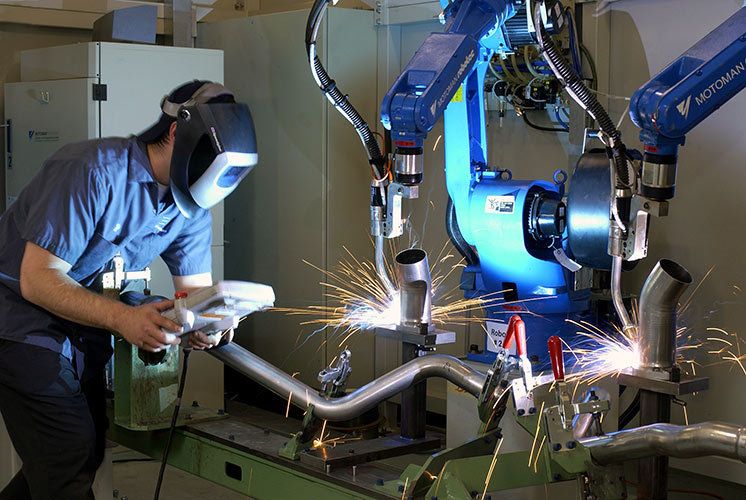
Modern robotic welding machines integrate intelligent control systems, programmable robotic arms, advanced sensors, and real-time monitoring technologies. From automotive manufacturing to heavy machinery production, robotic welding has become an essential part of modern industrial automation.
This guide explains Robotic Welding Machines, their working principles, major components, applications, maintenance practices, safety considerations, and the latest innovations in robotic welding technology.
What Is a Robotic Welding Machine?
A Robotic Welding Machine is an automated welding system that uses a programmable robotic arm to perform welding operations with minimal manual intervention. The robot follows pre-programmed movement paths while controlling welding parameters to produce consistent welds on components and assemblies.
Robotic welding systems are commonly used with:
Steel
Stainless steel
Aluminum
Carbon steel
Structural components
Automotive parts
Industrial equipment
Metal frames
Pipe assemblies
Fabricated products
The type of welding process depends on the material, joint design, and production requirements.
Why Robotic Welding Machines Matter
Automation has become an important part of modern manufacturing.
Robotic welding machines help:
Improve weld consistency
Increase production efficiency
Reduce repetitive manual operations
Support continuous manufacturing
Improve process repeatability
Enhance production planning
These advantages make robotic welding suitable for both medium- and high-volume manufacturing environments.
How a Robotic Welding Machine Works
The welding process follows several carefully controlled stages.
Component Positioning
Workpieces are accurately positioned using fixtures or automated handling systems.
Program Selection
Operators select the appropriate welding program based on the product being manufactured.
Robotic Movement
The robotic arm moves precisely along the programmed welding path while maintaining correct torch positioning.
Welding Operation
The welding process joins metal components using controlled heat and filler material where required.
Inspection
Completed welds are inspected through visual checks, measurement systems, or automated quality inspection technologies.
Main Components of a Robotic Welding Machine
Modern robotic welding systems consist of several integrated components.
Key components include:
Robotic arm
Welding power source
Welding torch
Wire feeder
Controller
Positioner
Fixtures
Safety enclosure
Sensors
Human-machine interface (HMI)
Each component contributes to accurate and reliable welding operations.
Common Welding Processes
Robotic systems support multiple welding methods.
Examples include:
MIG welding
MAG welding
TIG welding
Spot welding
Laser welding
Arc welding
Plasma welding
The selected process depends on the material type, thickness, and production objectives.
Applications Across Industries
Robotic welding machines support numerous industrial sectors.
Automotive Manufacturing
Vehicle frames, body panels, exhaust systems, and structural components are commonly welded using robotic systems.
Heavy Equipment Manufacturing
Construction machinery and industrial equipment require durable welded assemblies.
Metal Fabrication
Fabrication facilities use robotic welding for repetitive production tasks.
Aerospace Manufacturing
Certain aerospace components require highly controlled welding operations.
Shipbuilding
Large structural sections and marine components benefit from automated welding solutions.
Technologies Supporting Modern Robotic Welding
Today's robotic welding machines increasingly incorporate advanced technologies.
Examples include:
Industrial Internet of Things (IIoT)
Artificial intelligence-assisted path optimization
Machine vision systems
Laser seam tracking
Real-time weld monitoring
Predictive maintenance software
Digital twin simulation
Remote equipment diagnostics
These technologies improve production efficiency while supporting consistent weld quality.
Robotic Welding Machine Overview
| Process Stage | Primary Purpose |
|---|---|
| Component Positioning | Secure workpieces |
| Program Selection | Load welding instructions |
| Robotic Welding | Perform automated welds |
| Quality Inspection | Verify weld quality |
| Data Monitoring | Track production performance |
| Maintenance | Support reliable operation |
Quality Control
Quality management is essential in automated welding.
Inspection activities commonly include:
Weld appearance inspection
Dimensional verification
Weld penetration evaluation
Robot calibration checks
Sensor performance monitoring
Production data analysis
These procedures help maintain consistent manufacturing quality.
Maintenance Considerations
Routine maintenance supports dependable robotic performance.
Typical maintenance includes:
Inspecting welding torches
Replacing worn consumables
Checking robotic joints
Monitoring sensors
Calibrating robotic movement
Reviewing maintenance records
Preventive maintenance helps improve equipment reliability and reduce unexpected downtime.
Safety Considerations
Robotic welding systems operate with high temperatures, electrical equipment, and moving machinery.
Important safety practices include:
Following operating procedures
Using suitable protective equipment
Maintaining safety barriers
Inspecting emergency stop systems
Monitoring welding ventilation
Restricting access during automated operation
These measures contribute to safe industrial environments.
Environmental Considerations
Modern manufacturing increasingly emphasizes sustainable production.
Common initiatives include:
Energy-efficient welding equipment
Reduced material waste
Optimized welding parameters
Efficient production planning
Fume extraction systems
Digital energy monitoring
These approaches support environmentally responsible manufacturing.
Current Industry Trends
Robotic welding technology continues advancing through innovation.
Recent developments include:
Collaborative welding robots
Artificial intelligence-assisted programming
Smart factory integration
Digital production monitoring
Adaptive welding systems
Advanced machine vision
Connected manufacturing platforms
These developments continue improving productivity and process flexibility.
Looking Ahead
Future Robotic Welding Machines are expected to feature greater autonomy, enhanced artificial intelligence, improved vision systems, and tighter integration with Industry 4.0 manufacturing environments. Advances in machine learning, robotics, and digital simulation are also likely to support higher precision, predictive maintenance, and more flexible production processes.
Why Understanding Robotic Welding Machines Matters
Learning about a Robotic Welding Machine provides valuable insight into one of the most important automation technologies used in modern manufacturing. From component positioning and welding to quality inspection and digital monitoring, these systems help improve production efficiency, consistency, and operational reliability across many industries.
Conclusion
A Robotic Welding Machine is an essential part of modern industrial automation, enabling precise, repeatable, and efficient welding operations across automotive, aerospace, fabrication, heavy equipment, and other manufacturing sectors. Through advanced robotics, intelligent control systems, digital monitoring, and regular maintenance, robotic welding continues to support high-quality manufacturing while adapting to the evolving demands of Industry 4.0.

Related Post...
Industrial Gas Turbine Essential Insights for Industrial and Utility Operations
Updated: September 04, 2026
Read More
X Ray Machinery Guide of Components Applications and Imaging Processes
Updated: September 08, 2026
Read More
Discover How Industrial Vacuum Drying Supports Advanced Industrial Processing
Updated: September 15, 2026
Read More